Methods of Valuation of a Building | Building Estimation and Costing

Valuation of Building

Valuation of a building depends on the type of the building, its structure and durability, on the situation, size, shape, frontage, width of roadways, the quality of materials used in the construction and present day prices of materials. Valuation also depends on the height of the building, height of the plinth, thickness of the wall, nature of the floor, roof, doors, windows etc.

The valuation of a building is determined on working out its cost of construction at present day rate and allowing a suitable depreciation.
Six Methods of Valuation

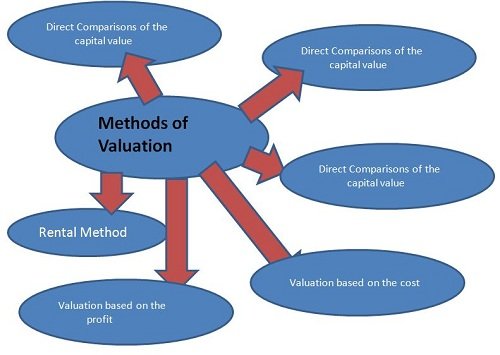
Six Methods of Valuation

  1. Rental Method of Valuation
  2. Direct Comparisons of the capital value
  3. Valuation based on the profit
  4. Valuation based on the cost
  5. Development method of Valuation
  6. Depreciation method of Valuation

Rental Method of Valuation

In this method, the net income by way of rent is found out by deducting all outgoing from the gross rent. A suitable rate of interest as prevailing in the market is assumed and Year’s purchase is calculated. This net income multiplied by Year’s Purchase gives the capitalized value or valuation of the property. This method is applicable only when the rent is known or probable rent is determined by enquiries.

Read more

Financing of Projects | Economics related to Architecture and Engineering

Financing of Projects | Economics related to Building Industry

Financing of Projects is the most important factor determining the success of the project. Various factors influence the success of a project.

In this article, we are going to study the major factors that are responsible for the success of the Building project…

Here are the four factors:

  1. Sources
  2. Total Cost Estimation of the Project
  3. Utility in Financing
  4. Agencies and Institutions directly and indirectly influencing the economic aspects of  a project

Sources

Loans are available for both purchasers and Builders from:

All Nationalized Banks,

Co-operative Banks,

Private Banks,

LIC HFL,

Finance Companies,

Insurance Companies like General Insurance Co (GIC), United India Insurance Co Ltd, National Insurance Co Ltd, Oriental Insurance Co Ltd, New India Assurance Co Ltd (for the employees), Foreign Direct Investment FDI, 20 Nationalised Banks along with Regional Rural Banks come under Public sector.

Commercial Banks, Cooperative Banks operate under provisions of Cooperative societies Law of states – for credit and non-credit purpose.

Read more

Column Layout for a Residence | Civil Engineering

Column Layout for a residence using the Thumb rules | Building Construction

In my earlier article, we discussed three important thumb rules that are to be followed while making a column layout for any building. They are as follows:

  1. Size of the Columns
  2. Distance between the columns
  3. Alignment of Columns

In this article, we will see an example of a residence of which column layout is done keeping the above three thumb rules in mind.

Column Layout for a residence

The residential villa comprises of 1 and half floors. Initially, the column size 9″x12″ had been used with the use of M15 grade of concrete. The builder wanted to save on his budget by making the columns smaller in size. That is why, the columns in the Floor plans below are 9″x9″ in size but the Engineer made sure that M20 grade of concrete would be used for Columns.

Column Layout for a Ground Floor

Read more

Design of different types of Parking Methods

Parking Methods

When an Architect or an Engineer is designing Roads; he must take care that he designs the required Parking Areas as per the requirement and the study of the traffic in that area.

The Parking Methods play a major role in controlling traffic and avoid chaotic confusion and traffic jams because of lack of Parking facility.

Parking Lot, New York

On the basis of the style of Parking Areas, there are two major types of Parking:

  1. On Street Parking
  2. Off Street Parking

In my earlier article, we discussed;

  1. Means of Access and Design factors to be considered for the design of roads
  2. Important elements to be considered in Road Design
  3. Types of Road Junctions

In this article, we will discuss “Types of Parking in detail” which will help us figure out the efficient way to designing Parking areas for Highways, Arterial roads, sub-arterial roads etc.

On Street Parking

As the name itself suggests, “On-street Parking” means the area allotted for Parking purpose at the sides of the roads. For efficiency in Parking system; the On street Parking is divided into two types:

  1. Angular Parking
  2. Parallel Parking
  3. Perpendicular Parking (efficient Parking Method)

Read more

Importance of Daylighting | Components of Daylight factor

Daylighting | Components of Daylight factor

Daylighting is the practice of the designing various types of openings to admit daylight into the working space for efficient and comfortable living. The orientation, shape and size of the openings play an important role in daylighting.

Daylighting could be provided with the help of windows, skylights, courtyards etc.

Skylight providing internal illuminance

Daylight factor

Daylight factor can be defined as the sum of all daylight reaching an indoor reference point.

The three important components considered for the estimation of total amount of daylight reaching a particular point is as follows:

  1. Direct light of the sun
  2. External surfaces reflecting light directly to the point
  3. Internal surfaces reflecting and interreflecting light to the point

Each of the three components when expressed as a ratio or percent of the simultaneous external illuminance defines the sky component (SC), external reflected component (ERC) and internal reflected component.

Read more

Ohio Stadium | Largest Football Stadium in Ohio, United States

Ohio Stadium is the centre for the Buckeyes football team at The Ohio State University. It is popularly known as The Shoe, The Horseshoe or The House that Harley Built. The Ohio stadium is located in Columbus, Ohio, United States.

Ohio Stadium, Columbus, United States

This stadium has gained quite a lot of historical importance. Its name was added to the National Register of Historic Places by the National Park Service on March 22, 1974.

  • It has a capacity of accommodating 102,329, people. It is the third largest stadium in the NCAA and the sixth largest non-racing stadium in the world.
  • It is also the largest stadium in Ohio, Columbus, United States.
  • Ohio Stadium is also used for organizing concerts. Famous plays that of U2, The Rolling Stones, Pink Floyd & Metallica have also been played at Ohio Stadium.

Read more

Micro Economics and Macro Economics | Engineering Economics

The study of economics is broadly divided into two categories:

  1. Micro Economics
  2. Macro Economics

In our previous article “Introduction to Building Economics as related to Architecture“, we discussed certain important terms relating to Building Economics. This article is the continuation of the study of Micro Economics and Macro Economics. This article will give you a brief idea of Macro Economics and Micro Economics.

Micro Economics

It is a small part of whole economics which deals with individuals, their needs, their behaviour, individual firms and its activities. This deals with studies like incomes, capital spending on building, individuals who are engaged in various products for building construction.

Micro-economics is also called Price Theory.

Importance of Micro-economics

It analyses how millions of consumers and producers in an economy take decisions about products and services offered. It also deals with how buildings and services are distributed belonging to different economic status.

Limitations

  • It cannot give an idea of the function of the economy as a whole.
  • It assumes full employment which is a rare phenomenon in developing countries or even developed countries which is quite unrealistic.

Read more

Types of Scales in Engineering Surveying

Types of Scales | Engineering Surveying

In the previous article, we discussed briefly on the topic of “Scales in Surveying” where we came across an important term “Representative factor” which forms an important part in understanding the scales in Surveying.

In this article, we will discuss different types of scales used in Surveying…

The scales are classified into four categories:

  1. Plain Scale
  2. Diagonal Scale
  3. Vernier Scale
  4. Scale of chords

Lets go on with the discussion of types of scales briefly for our better understanding…

Plain Scale

Plain Scale is one on which it is possible to measure two dimensions only. For example, measurements such as units and lengths, metres and decimetres etc.

Plain Scale
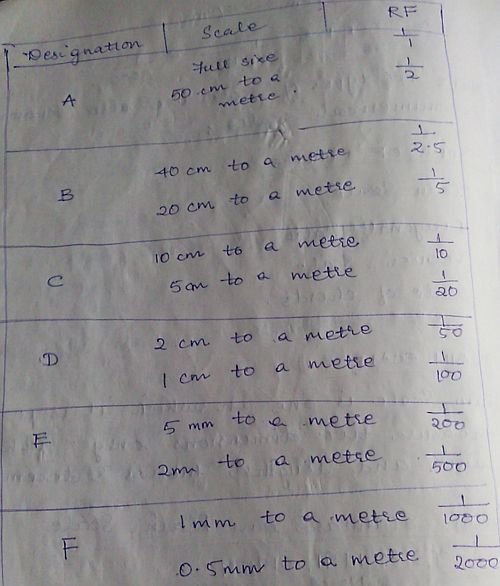
Plain Scale

Six different plain scales in metric used by engineers, Architects and Surveyors.

Diagonal Scale

On diagonal scale, it is possible to measure three dimensions such as metres, decimetres and centimetres, units , tens and hundreds; yards, feet and inches etc.

A short length is divided into number of parts using the principle of similar triangle in which sides are proportional.

Read more

Methods of Calculation of Areas in Surveying | Simpson’s Rule

Calculation of Areas in Surveying | Simpson’s Rule

In one of my previous articles, I discussed Midpoint Ordinate Rule and Average Ordinate Rule in detail with an example and listed out various important methods used for the calculation of areas in Surveying. In this article, we will deal with the next important method (rule) i.e. Simpson’s Rule along with a numerical example used for the calculation of areas in the field of Surveying.

Here are the five important rules (Methods) used for the calculation of areas in Surveying:

  1. Midpoint ordinate rule
  2. Average ordinate rule
  3. Simpson’s rule
  4. Trapezoidal rule
  5. Graphical rule

Simpson’s Rule

Statement

It states that, sum of first and last ordinates has to be done. Add twice the sum of remaining odd ordinates and four times the sum of remaining even ordinates. Multiply to this total sum by 1/3rd of the common distance between the ordinates which gives the required area.

Where O1, O2, O3, …. On are the lengths of the ordinates

d = common distance

n = number of divisions

Note:

This rule is applicable only if ordinates are odd, i.e. even number of divisions.

If the number of ordinates are even, the area of last division maybe calculated separated and added to the result obtained by applying Simpson’s rule to two remaining ordinates.

Read more

Next Generation Internet | Web 3.0

Web 3.0, a phrase coined by John Markoff of the New York Times in 2006, refers to a supposed third generation of Internet-based services that collectively comprise what might be called ‘the intelligent Web’—such as those using semantic web, microformats, natural language search, data mining, machine learning, recommendation agents, and artificial intelligence technologies – which emphasize machine-facilitated understanding of information in order to provide a more productive and intuitive user experience.

Web 3.0 Next Generation Internet

CEO of Google.com, Eric Schmidt gave a speech about Web 3.0 in Korea in May 2007…

Read more