Numerical Examples for Errors in Chain Surveying

A practical Example for Calculation of the True Area of the field | Errors in Chain Surveying

In my previous article, we studied how to measure true distance considering the Errors occurring in Surveying.

Correction formulas to be kept in mind (for incorrect length of Chain)

True distance = L’/L*measured distance

True area = (L’/L)2*measured area

True Volume = (L’/L)3 * measured volume

Where, L’ = incorrect length of chain

L = correct length of chain

The chain was tested before starting the surveying and was found to be 20m. At the end of surveying, it was tested again and was found to be 20.12m. The area of the plan of the field drawn to a scale 1cm = 6m was 50.4sqm. Find the true area of the field in sqcm.

Read more

Chaining on Sloping Ground | Guide to Surveying and Levelling

Chaining on Sloping Ground | Surveying and Levelling

There are two methods for determining horizontal distance on sloping ground.

  1. Direct Method
  2. Indirect Method

Direct Method of Chain Surveying

This method is also known as “Stepping Method”.

The horizontal distances are directly measured by the process of stepping.

Procedure

A path of chain or tape is stretched out from ‘P’.

The path length of chain or tape depends on the steepness of the ground.

The follower holds the zero end of the chain at ‘P’ and directs the leader at P1 to be in the line of PQ and stretch the chain or tape above the ground in horizontal line.

Direct Method | Chain Surveying

The leader then transfers the point ‘P1’ to P2 on the ground by means of plumb bob or dropping a pebble or an arrow,

Now the followers take the new position ‘P2’ and directs the leader to move forward and stretch the tape or chain in a line of PQ.

Now the followers take the new position ‘P2’ and directs the leader to move forward and stretch the tape or chain in a line of PQ and the new position is P3.

Again the leader transfers the point P3 to P4 on the ground as done earlier.

This process is repeated till the point Q is reached.

Horizontal distance PQ = S1 + S2 + S3 + S4 + S5

Read more

Development in Structural Systems in Postmodernist Period

Evolution of Structural Systems in Postmodernism

Before 20th century, there were three great developments in structural systems.

Bulk Active structure is classified as followed:

  1. Post and lintel
  2. Arch system

Dome and vault construction (either in the form of bulk, employing plastic materials i.e. concrete, hardening into a homogeneous mass or the thrust type, in which the loads are received and counterbalanced at definite points; steel-glass skeleton system.


St. Peter's Dome
St. Peter's Dome


After World War II, the analysis of building types provides information behind each of the greater styles. This can easily be understood that it was not merely a trend, but a period of serious and required experimentation directed toward answering the needs of a specific way of life. In the era, most of the construction work was dominated by sustainable building design, construction and using materials in ways that minimize toxic production methods and in using natural sunlight for energy and natural air movement and water for cooling, climate, methods of labour, available materials, and economy of means thus impose their dictates.

Read more

Guide to Design of Simple Beam | Design of Steel Structures

Design of Simple Beam

A member carrying loads perpendicular to its axis is defined as a beam.

For a simple floor beam, I-sections are used.

M/I = (sigma) /y

M = (I/y)(sigma)

I/y = Z (section modulus)

Therefore, M = z(sigma)

When beams are loaded, bending stresses are developed at all sections.

The bending stresses developed in beams can be determined by the equation theory of simple bending.

For laterally supported beams, the permissible bending stress in tension as well as in compression should not exceed (sigma)bc or (sigma)bt = 0.66fy

For laterally unsupported beams, the permissible stress in bending compression is calculated by using tables from the the IS code book (IS:800).

Load carrying capacity of the Beam

From structural steel tables for the given beam, the section modulus (Zxx) is obtained.

Depending upon whether the beam is laterally restrained or unrestrained; the value of permissible stress in bending compression ((sigma)bc) is calculated.

The moment of resistance of the beam is found out.

MR = Zxx .(sigma)bc

Equating the moment of resistance to the maximum bending moment equation, the total load (w) the beam can carry is calculated.

Practical Problems related to Construction on Site | Building Construction

General Construction Problems on Site

Getting fine aggregate free from dust, clay, salts etc.

  • Silt clay and silt (sizes below 70M)
  • (sizes below 4-5M)
Practical Construction Problems on site

Being small, they absorb lot of water. Water available for cement hydration is less, leaves pores. Clay and silt affect the gel formation. As it does not participate in gel formation, denser cone is not formed. Durability is reduced.

Clay particles tend to flocculate due to cohesion and under stress, may tend to break resulting in voids, therefore weak concrete. These clay particles coat the coarse aggregate, thus presetting the bond between the coating of cement and coarse aggregate. This seriously affects the strength.

Therefore, sand containing silt and clay should be summarily rejected or through washing of sand but expensive.

Quality of water

  • Many it is hard water that is available at site. For food concreting job, it requires portable soft water, as the salt contents in hard water may affect the gel formation.

Read more

Underwater Lighting Techniques | Aqua Architecture

Under water lighting deals with the lighting systems placed inside water entities like swimming pools , fountains , etc , and some times even in smaller areas like Jacuzzis . This aspect of lighting mainly depends on the various physical properties of water ( refraction , reflection etc of stand still and moving water). Under water lighting also deals with the effects of lighting placed above water , on and in water.

Figure showing a water fall lit from beneath showing the ‘Glowing steps ‘ effect

Under water lighting also deals with the effects of lighting placed above water , on and in water.

Read more

Spot Lighting | Lighting Techniques

Lighting Techniques

Lighting Techniques play a very important role in creating soothing ambience. It could be a room, a residence, a building facade or ambient lighting in the Landscaped Gardens…

Laser Effects
Laser Effects

The Lighting Technique is different for different purposes….

For example: Dining Lighting Techniques are different from Underwater Lighting Techniques… The kind of lights used in the Underwater Lighting system are different from that of the lights used in Dining Lighting and for specific purpose such as Task Lighting.

The material of the lights used for lighting varies for the type of ambiance it is supposed to create. The material of the underwater lights is different from the material of the other lights used for other purposes.

In this article we are going to discuss different types of Spotlights and situations where it is used.

Read more

New Changing trends in the Materials and Furniture design | Interior Design

Changing trends in the choice of Building materials

Nowadays, people are gaining more knowledge about eco-friendly lifestyle. They are realizing that eco-friendly materials are much better and safer as compared to the synthetic and energy intensive materials. Though use of synthetic materials give a very stylish and trendy look to the place, they are not eco-friendly. The trend is definitely away from the older classical looks, associated with bygone grandeur and towards more contemporary styling. Fabric is more textured and interesting, with graphics, florals and interesting weaves and patterns to the fore.

Fabric used as a material for covering the furniture

The palette is lighter and brighter than before, in keeping with the move away from the traditonal to the contemporary, also following what is seen as international, stylish and sophisticated. Instead of saying ‘the look has changed’, I would rather say the look and feel of traditional interiors has evolved. New design languages generated by new materials and new uses of existing materials have resulted in a truly matured genre of beautiful and amazing interiors.

Read more

Independence Hall, Philadelphia | American Declaration of Independence

Independence Hall is a national landmark in United States. It is located in Philadelphia, Pennsylvania on the Chestnut street between 5th and 6th Streets. It achieved its importance primarily because this was the location where American Declaration of Independence (4th July, 1776)was signed and United States Constitution was debated and brought into force. It was further listed under the category of World Heritage Sites in 1979.

Independence Hall, Philadelphia (in 2005)

Construction of Independence Hall

Independence was constructed in Georgian Style which was prevalent and in practice in most of the English speaking countries between 1720 to 1840.

The hall was designed by two architects namely Edmund Woolley and Andrew Hamilton and its design was executed by Woolley. Red brick was used majorly for the construction of facades and this building was popularly known as “Red Brick Building”. It is 41m in height.

Read more

Consequences of Wrong Structural Design | RCC Structures

A lesson for all the Civil Engineers and Designers to learn

I got a project of designing (Architectural Design) a Hostel in Lucknow, India. The Structural design that is, column positions and wall construction was already done. The client wanted me to design a Hostel keeping the column positions and exterior wall construction intact. I have written this article to address all the Civil engineering students as well as Civil Engineers to avoid making such blunders while they design. Please do read this article because understanding the intensity of the job of a Civil Engineer is must for every student and professional. I guess this realization has been washed away and forgotten in the wave of commercialism.

Hostel Design, Lucknow, India

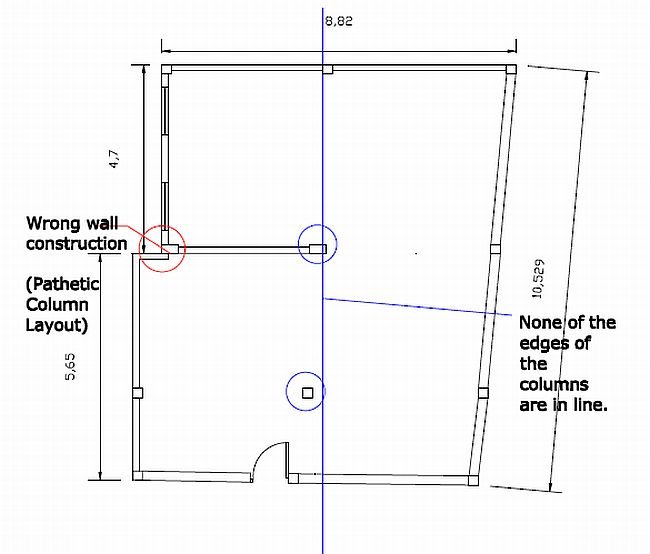
The client mailed me the layout of the existing construction. After I studied the layout, I figured out that the Column layout was pathetic. I wonder what kind of Civil Engineer must have made the layout or if at all any Civil Engineer has done it.

Errors in Construction

Wrong size of the Columns

The size of the columns was 9”x9” and the building is supposed to be constructed upto G+2 floors which is really disastrous for the structure.

It could lead to structural failure and ultimately structural collapse.

(The duty of the Civil Engineer is to understand and not make such dramatic blunders. The consequences of this kind of structural design could be disastrous.)

Column layout and Exterior wall Construction

9”x9” size columns are only preferred if you were to construct only a ground floor structure using M15 grade concrete. If you are to construct another floor that is (G+1), the minimum size of the column should not be less than 9”x12” using M15 grade concrete.

If the client insists on using smaller columns (9”x9”); in that case, use of M20 grade concrete should be done mandatorily and the construction should not be initiated before the client agrees to do so.

Read more