Field work in Chain survey | Surveying in Civil Engineering

Field work in Chain surveying | Surveying and Levelling

Earlier, we discussed “Principles of Chain Surveying” and the considerations that are taken for carrying out Chain Surveying… In this article, we will discuss various instruments that are essential for carrying out Chain Surveying.

Here are the steps to be followed for carrying out Chain Surveying:

  1. Reconnaissance Survey
  2. Marking stations
  3. Running survey lines
  4. Taking offsets

Instruments used in Chain Survey

  1. Chain, 20m or 30m long
  2. Tape
  3. Arrows
  4. Ranging rods
  5. Wooden or Iron Pegs
  6. Plumb bob
  7. Cross staff

Chain used for Surveying

20m chain – 100 links

30m chain – 150 links

1 links – 20cm

Links of chain are made by mild steel wire – 4mm diameter.

Chain used for Chain Surveying

Each link at the end is bent into a loop and is connected to adjoiningly by means of three oval rings which offers flexibility to the chain. Ends of chains carry brass handle.

Read more

Types of Measurements in Surveying | Civil Engineering

Types of Measurements in Surveying

Surveying is the art of making suitable measurements in horizontal or vertical planes. This is one of the important subjects of civil engineering. Without taking a survey of the plot where the construction is to be carried out, the work cannot begin.

From the above definition, we conclude on two types of measurements in surveying. They are as follows:

  1. Linear measurements
  2. Angular measurements

Now we will go on with the discussion of each of these types of measurements along with their subtypes.

Linear measurements are further classified as follows:

Horizontal Distance

Vertical Distance

Horizontal Distance

A horizontal distance is measured in horizontal plane if a distance is measured along a slope, it is reduced to its horizontal equivalent.

Horizontal Angle
Horizontal Angle

Vertical Distance

A vertical distance is measured along the direction of gravity at that point. The vertical distance are measured to determine difference in elevations in various points.

Read more

Purpose of Surveying | Civil Engineering

Purpose of Surveying in the field of Civil Engineering

  • To determine the relative positions of the existing futures of the ground.
  • To layout our marked positions of proposed structures on the ground.
Surveying | Land Survey
  • To determine areas, volumes and other related quantities.
  • To prepare a map of a country of detailed out location of cities, towns, villages and major roads.
  • To prepare the engineering detailed plans and sections of various sections such as roads, railways, bridges, dams and other structure.
  • To prepare a topographical map showing details of hills, valleys and rivers.

Scales used in Surveying | Engineering Surveys

Scales | Engineering Surveying

Scale is a fixed ratio that every distance on the plan bears with corresponding distance on the ground.

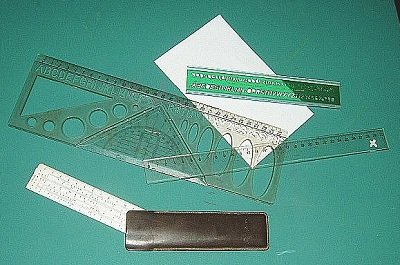
Rulers bearing a certain specific scale for measurement

Scale can be represented by the following method

One centimetre on the plan represents some whole number of the metres on the ground.

1cm = 10m

This type of scale is called engineering scale.

1 unit of length on the plan represents some number of same units of length on the ground.

1/1000 etc…

This ratio of map distance to the corresponding ground distance independent of units of measurement is called Representative Factor (RF).

For example,

1cm = 50m

RF = 1/(50×100) = 1/5000

Above two types of scales are also known as numerical scales.

Read more

Classification of Surveys according to their field of Work | Engineering Surveying

Classification of Surveys according to the field of work | Surveying and Levelling

In one of my previous articles regarding “Classification of Surveys“, discussion of various types of surveys have been listed out. We are now proceeding with the detail study of different types of surveys under the category of field of work.

The classification for the field of work is as follows:

Land Survey

This involved survey of objects in earth’s surface.

German Soldier carrying out Land Survey to determine the natural features and determine areas of strategic importance

Read more

Classification of Surveys according to the methods Employed in Surveying

Classification of Surveys according to the methods employed | Civil Engineering

In our previous articles, we discussed classification of Surveys according to their purpose in Surveying. Now we will go on with the discussion on classification of surveys according to the method of work.

Here are the two methods employed for Surveying:

  1. Triangulation Survey
  2. Transverse Survey

Triangulation Survey

The selected survey stations are connected with survey lines in such a way resulting in the formation of network of triangles. This survey is useful in surveying larger areas with uneven site boundaries.

The various formulas of the triangle are used to determine and area and various dimensions of the site.

Right angled triangle - (A = 1/2*base*height)

Transverse Survey

The whole area is divided into various transverses for the easy surveying. Since this method involves division of survey area into various transverse, it is termed as Transverse Survey.

A transverse is a geometrical figure consisting of more than three sides.

Classification of Surveys and Surveying Methods in Engineering

Classification of Survey

Study of classification of surveys is a major part of the study of Surveying as a whole. The surveys are conducted using various different instruments. The use of instruments depend upon its availability and suitability to the site.

Surveys are classified as following:

  1. According to the instruments used for the survey
  2. According to the purpose of the survey
  3. According to the method employed for the survey
  4. According to the field of work

In this article, we will list out the classification in each and category and study them in detail…

According to the instruments used

Chain Survey

Chain Survey is conducted using different lengths of chains specifically made for the surveying purpose.

Compass Survey

As the name itself suggests, the compass is used for the purpose of the survey.

Plane table Survey

Plane table is used for the purpose.

Levelling

Theodolite Survey

Theodolite is an instrument that is useful for conducting accurate surveys.

Read more

Introduction to Surveying | Civil Engineering

Surveying

Surveying is the art of making suitable measurements in horizontal or vertical planes. This is one of the important subjects of civil engineering. Without taking a survey of the plot where the construction is to be carried out, the work cannot begin.

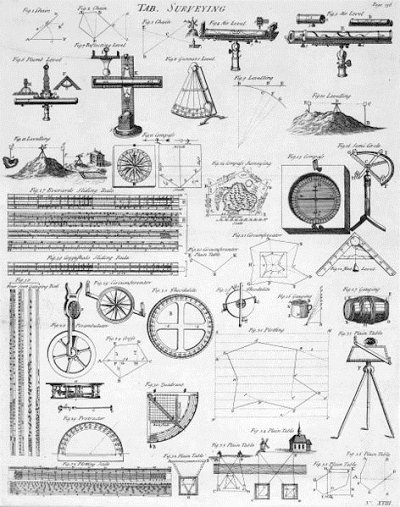
Surveying Chart
Surveying Chart

Levelling

Levelling is the art of representing relative positions in the vertical plane of different points on the earth’s surface.

It helps in determining the areas that are to be levelled to achieve a certain slope.

Principles of Surveying

All the surveys that are conducted are based on two fundamental principles. They are as follows:

  1. Working from whole to part
  2. Fixing a point with reference to two fixed points

Working from whole to part

In order to localize errors and prevent their accumulation, a set of control points is always established with great precision first for the whole area to be surveyed.

Later on, details or filled in between these control points to a relatively smaller precision.

This fundamental work principle is known as “Working from whole to part”.

Fixing a point with reference to two fixed points

Survey stations are fixed by atleast two measurements, either both linear or angular measurements or linear and angular measurements from two control points.

Read more