Archive for February, 2010
Theory of Built-up Sections
Posted by BenzuJK in Building Construction on February 20, 2010
- A built-up beam is also known as compound beam.
- The built-up beams are used when the span, load and corresponding bending moment are of such magnitudes that rolled steel beam section becomes inadequate to provide required section modulus.
- Built-up beams are also used when rolled steel beams are inadequate for limited depth.
- In building construction, the depth of beam is limited by a space provided by the architect.
- Drawing beam of small depth do not provide required section modulus. Therefore, plates are attached to the beams.
- The strength of rolled steel beams is increased by adding plates to its flange which is one of the method forming built-in section.
- The other method is to compound a number of rolled steel sections themselves.

The built-up sections shown in figure’ A’ and ‘B’ are used for heavy loads and small spans.
Various types of Roof trusses for various spans
Posted by BenzuJK in Building Construction on February 6, 2010
What is a Truss?
- In Architecture and Structural Engineering, a truss is a structure comprising one or more triangular units constructed with straight slender members whose ends are connected at joints referred to as nodes.
- External forces and reactions to those forces are considered to act only at the nodes and result in forces in the members which are either tensile or compressive forces.
- Moments (torsional forces) are explicitly excluded because, and only because, all the joints in a truss are treated as revolutes.
In this article, we are going to discuss the various types of roof trusses in wood and steel and their uses in various kinds of construction.
Different types of Wooden and Steel Roof Trusses:
- King Post Truss
- Queen Post Truss
- Howe Truss
- Pratt Truss
- Fan Truss
- North Light Roof Truss
- Quadrangular Roof Truss
Trusses for large span constructions
King Post Truss

King Post roof truss (spans upto8M)
- King Post Truss is a wooden truss.
- It can also be built of combination of wood and steel.
- It can be used for spans upto 8m.
Column Bases | Design of Steel Structures
Posted by BenzuJK in Building Construction on February 5, 2010
Column bases are structural elements used in the design of steel structures to transfer the column load to the footings.
Types of Column bases
- Slab base
- Gusseted base
Slab Base

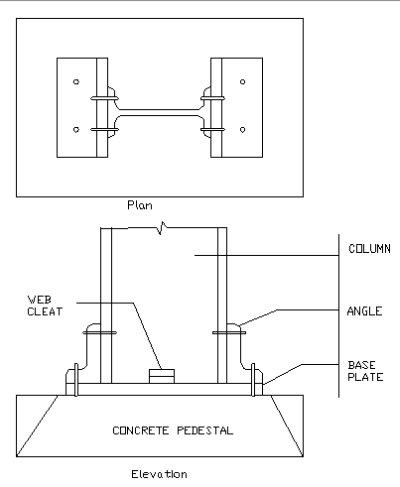
Slab bases are used where the columns have independent concrete pedestals. A thick steel base plate and two cleat angles connecting the flanges of the column to the base plate. In addition to these, web cleats are provided to connect the web of the column to the base plate. These web cleats guard against the possible dislocation of the column during erection. The ends of the column and also the base plate should be mechanized so that the column load is wholly transferred to the base plate.
Area of base plate= (load of column)/(permissible bearing stress in concrete)
Hollow Cement Block Partitions
Posted by BenzuJK in Building Construction on February 4, 2010
What are Hollow Cement Blocks?
Hollow and dense cement concrete blocks known as hollow blocks, have been developed as an alternative to bricks. The products are widely used in construction activity. They are lighter than bricks, easier to place and also confer economics in foundation cost and consumption of the cement. The hollow blocks are made of cement, stone chips, stone dust and sand are not onlycheaper than bricks but have other specialities as well. These blocks have more tensile strength, the walls constructed from these blocks act as thermal insulaters because of their hollowness.

Hollow Cement Blocks Partition
These blocks find wide applicability and construction cost is largely reduced. It is also observed that there is good demand for housing activity among tribals. As the construction activity is growing day by day, there is a good demand for hollow and cement concrete bricks.